
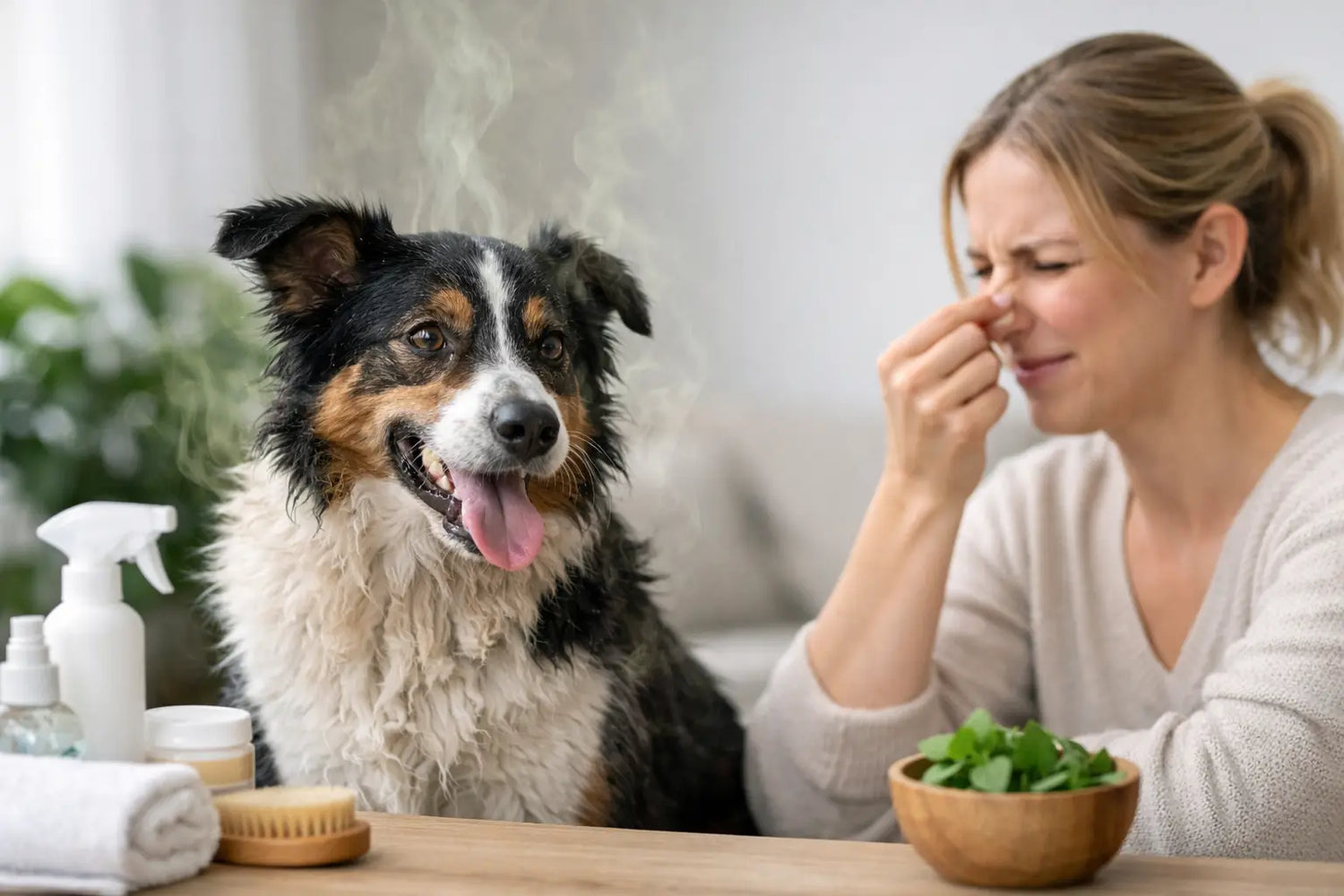
If your dog has a strong odor that returns shortly after a bath, the point is not to cover it up with a scented shampoo. When searching for “dog with bad odor remedies,” you are almost always observing a specific signal: altered skin, inflamed ears, bad breath, or a coat that can no longer maintain its natural balance.
Dog with bad odor: useful remedies start from the cause
A healthy dog has a natural smell, but it should not be acrid, rancid, or persistent. If the bad odor is concentrated on the skin, there is often excessive sebum production, irritated skin, or inappropriate cleansing. If it comes from the ears, the problem may be the accumulation of earwax, moisture, or a local sensitivity that promotes redness and microbial proliferation. If the odor comes from the mouth, the suspicion falls on plaque, inflamed gums, or imbalances in the oral cavity.
This is the point many underestimate: remedies change depending on the origin of the problem. Washing more does not always help. In some cases, it worsens the condition because already stressed skin reacts by producing even more sebum or becoming further irritated.
When the bad odor comes from the skin and coat
The skin is the first major suspect. A coat that smells bad even a few days after washing may indicate a weakened skin barrier. This often happens in dogs with sensitive skin, allergic subjects, animals that lick themselves a lot, or that have red and moist areas.
In these situations, a routine is needed that cleans without attacking and supports the skin’s physiology. Overly degreasing cleansers give an immediate clean feeling but can leave the skin more vulnerable. Much more useful is a dermofunctional cleansing, with natural ingredients able to soothe, hydrate, and support the recovery of the skin barrier.
Aloe Arborescens is a particularly interesting active ingredient in this context because it helps soothe stressed skin and keep it more balanced. Carrot, thanks to its functional compounds, supports skin well-being and contributes to protecting skin subjected to irritation. When these ingredients are processed with gentle methods, such as the cold HDR method, the value of the raw material remains more intact and the support on the skin is more consistent with a natural but concrete strategy.
If the dog emits a bad odor from the body, the first truly sensible remedy is therefore this: treat the skin as a tissue to rebalance, not as a surface to degrease.
Signs to observe at home
There are details that help understand if the problem is skin-related. The dog scratches more than usual, licks paws and groin, has red skin, dandruff, greasy fur, or small localized odors in the folds. Sometimes there is an added sensation of a “stale” or “greasy” smell that returns quickly.
In these cases, it is advisable to always dry the coat well after bathing or rain, check the skin folds, and use specific pet products, not cleansers designed for people. Dog skin has a different balance and is very sensitive to wrong formulations.
Bad odor from the ears: a common problem
If the odor is strong and concentrated near the head, the cause is often auricular. Dog ears, especially in certain breeds or predisposed subjects, can accumulate earwax and moisture. This creates an environment favorable to irritation and bad odor.
The remedy, again, is not to improvise. Cotton swabs and aggressive cleaning tend to push material deeper or irritate the canal. It is much better to choose a gentle ear solution, formulated to help clean and maintain local balance.
When the area is already sensitive, natural ingredients with soothing and protective action can make a difference in the routine. Aloe Arborescens and complementary actives used in well-designed ear products help cleanse respectfully, supporting tissues without stressing them. This approach is especially useful in dogs that have recurring episodes of smelly ears and require constant management, not just sporadic interventions.
When to see the veterinarian
If the odor from the ears is very strong, if you see dark secretions, the dog shakes its head often, or shows pain, veterinary evaluation is necessary. Home treatment is fine as support or maintenance but should not delay diagnosis when there are signs of otitis or significant inflammation.
Bad breath in dogs: it’s not just a nuisance
Many owners notice bad odor when the dog approaches or yawns. Bad breath is not a trivial detail. It often signals plaque buildup, tartar, gum irritation, or poor daily oral hygiene.
Here too, a simple rule applies: masking the odor is of little use. You need to intervene in the oral environment. A good routine includes regular check-ups, specific oral products, and constant support, especially in small dogs or subjects more prone to dental problems.
Nutraceutical and functional products for oral support make sense precisely because they work more broadly on mouth well-being, helping maintain gums and mucous membranes in better condition. When the formulation includes natural ingredients known for their soothing and protective action, the benefit is not only on the odor but on the quality of the daily routine.
Do natural remedies really work?
Yes, if they are part of a correct strategy. No, if used as a shortcut without asking where the problem comes from.
A serious natural remedy is not “something that smells good.” It is a solution that supports the physiology of the skin, ear, or oral cavity with functional actives and formulations designed for the animal. For this reason, it is important to distinguish between generic cosmetics and targeted dermofunctional or nutraceutical products.
In daily work on skin and mucous membranes, Aloe Arborescens plays a very interesting role for its ability to support stressed tissues. Carrot adds useful support to skin trophism and protection thanks to its natural profile rich in functional components. If these ingredients are included in formulas developed for specific dog needs, the result is much more concrete than a casual approach.
Dog with bad odor: practical remedies for everyday routine
The most useful part, for those living with a dog, is to build a simple but consistent routine. If the problem is skin-related, a gentle and specific cleanser is better, used with the right frequency for that subject. If it concerns the ears, regular but not obsessive cleaning should be maintained. If bad breath is the main issue, oral supports and constant check-ups must be introduced.
The environment also matters. Damp kennels, poorly dried coats, too frequent baths, or unsuitable products can keep the problem alive. Sometimes changing the routine brings visible improvements in a short time; other times more patience is needed because the skin must recover its balance.
For those seeking a concrete and natural answer, the most sensible solution is to turn to specialist veterinary products that link the problem to the right active ingredient. It is the difference between trying and truly treating.
When bad odor should not be normalized
There are odors that should never be considered “the dog’s character.” A sudden, very intense bad odor, associated with itching, redness, secretions, lesions, or behavioral changes requires prompt attention. The dog communicates this way too, often before the problem becomes evident to the eyes.
Relying on a natural approach does not mean waiting too long. It means choosing respectful, effective, and well-formulated tools, inserted within conscious management. This is the logic that also guides the specialist solutions of Aloeplus Dogs and Cats: natural ingredients with high functionality, proprietary technology, and a concrete approach designed to give the owner real help in daily care.
If your dog smells bad, don’t stop at the surface. Observe where the problem starts, intervene with targeted products, and value prevention. Often well-being is recognized precisely by what you no longer smell.