
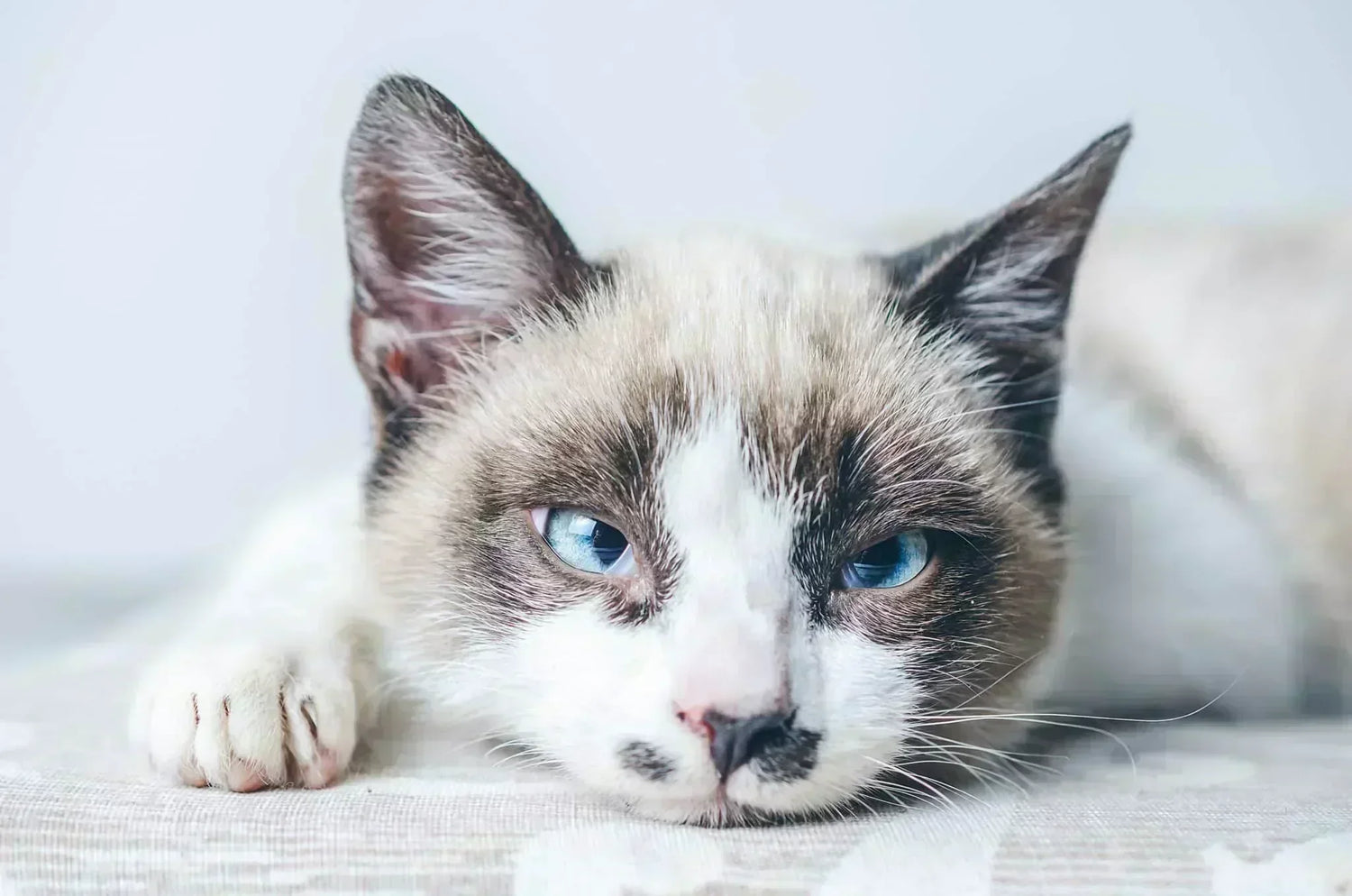
Today we want to tell you a story, that of a cat affected by stomatitis who encountered Aloe Arborescens on his path and how, for his stomatitis and his health, it was a blessing.
What happened? We tell you everything in this blog article.
It was an ordinary Monday at work when one of our representatives in the field knocked on the door of Dr. Di Franco's Veterinary Clinic in Venafro (IS).
The Doctor welcomes him warmly and our representative begins to explain a natural remedy against stomatitis with exceptional properties.
At one point, Dr. Di Franco jumps in his chair and says to him:
I have the perfect case to test it:
A cat affected by FIV, FELV, ulcers, gingivitis, and stomatitis, quite a severe case! We tried several medicines and unfortunately the situation does not improve.
The doctor said: "do you feel like accepting the challenge? If it works with this cat, it could be your lucky day."
The challenge was tough, but the representative confidently, without hesitation, ACCEPTED THE CHALLENGE.
Well, after 20 days the Doctor called us asking us to come to the clinic because he had big news.
Before revealing how the story ended, let's quickly see what stomatitis is.

What is Feline Stomatitis?
Feline stomatitis is a very painful inflammation of the gums and oral mucosa, affecting cats from 4 months to 17 years old. The incidence rate increases with age.
How does it manifest?
If the cat shows one of the following symptoms, it is very likely affected by feline stomatitis:
- Bad breath
- Red or bleeding gums
- Excessive salivation
- Mouth ulcers (canker sores)
- Loss of appetite
- Weight loss
- Dehydration
What is the cause that causes so much suffering?
Now let's look at the possible causes that can lead to stomatitis:
- FCV (Feline calicivirus)
- FIV (Feline immunodeficiency)
- FELV (Feline leukemia)
- Food-related inflammation
- Food intolerances
- Eosinophilic syndrome
- Viral infections
- Kidney failure
Although the most common cause remains immune-related.
In fact, cats affected by this condition, having an inadequate immune system, are hypersensitive to dental plaque bacteria and react with a devastating and painful inflammatory response.
How can it be treated?
As mentioned earlier, the inflammation and lesions that characterize stomatitis are extremely painful.
Treating chronic stomatitis in cats is a very tough challenge.
In cases of obvious disease and especially in the presence of significant pain, analgesics, anti-inflammatories, and antibiotics are used.
It is also important to emphasize that these are temporary remedies that rarely solve the problem.
These are only palliative measures used in acute phases, and when stopped, the oral inflammatory state is worse than before.
Almost always, partial or total tooth extraction is performed.
In severe cases, this is the only effective option.
What happens if no immediate action is taken?
Stomatitis is one of the most frustrating causes of chronic mouth pain; over time, gum inflammation will spread throughout the entire oral mucosa, causing so much discomfort that it makes your cat's life a living hell and consequently yours as well.

Well, we've come to the point! Let's return to the end of the story!
As soon as we arrived at the clinic, Dr. Di Franco, amazed by the results obtained with that fantastic natural remedy, showed us a detailed report:

Dr. Andrea Di Franco
Venafro Veterinary Clinic (Is)
” The cat tested positive for FIV and FELV, had ulcers on the tip of the tongue, severe gingivitis, and stomatitis that prevented her from eating.
After just three days of applications (I applied it manually on the ulcers and gums), the cat started eating wet food again. In my opinion, the product also works locally.
Six days later, we stopped all other medications and continued the therapy only with the product.
After 20 days of therapy, the clinical picture is stable, the ulcers have disappeared, and the cat has no problems. We did not repeat the tests, but I contacted the owners who report that the cat is currently stable and has had no relapses.”
The cat, in very critical condition, returned to health in just 20 days.
For cat stomatitis, aloe is a real remedy.
Curiosity:
Dr. Di Rocco, a veterinarian, created this natural therapeutic blend that contains over 250 active ingredients.
Why can this blend be so effective in your cat's stomatitis?
Thanks to the synergy of over 250 active ingredients within the product that have Immunomodulating, Anti-inflammatory, Healing, Pain-relieving, and Antibiotic properties.