
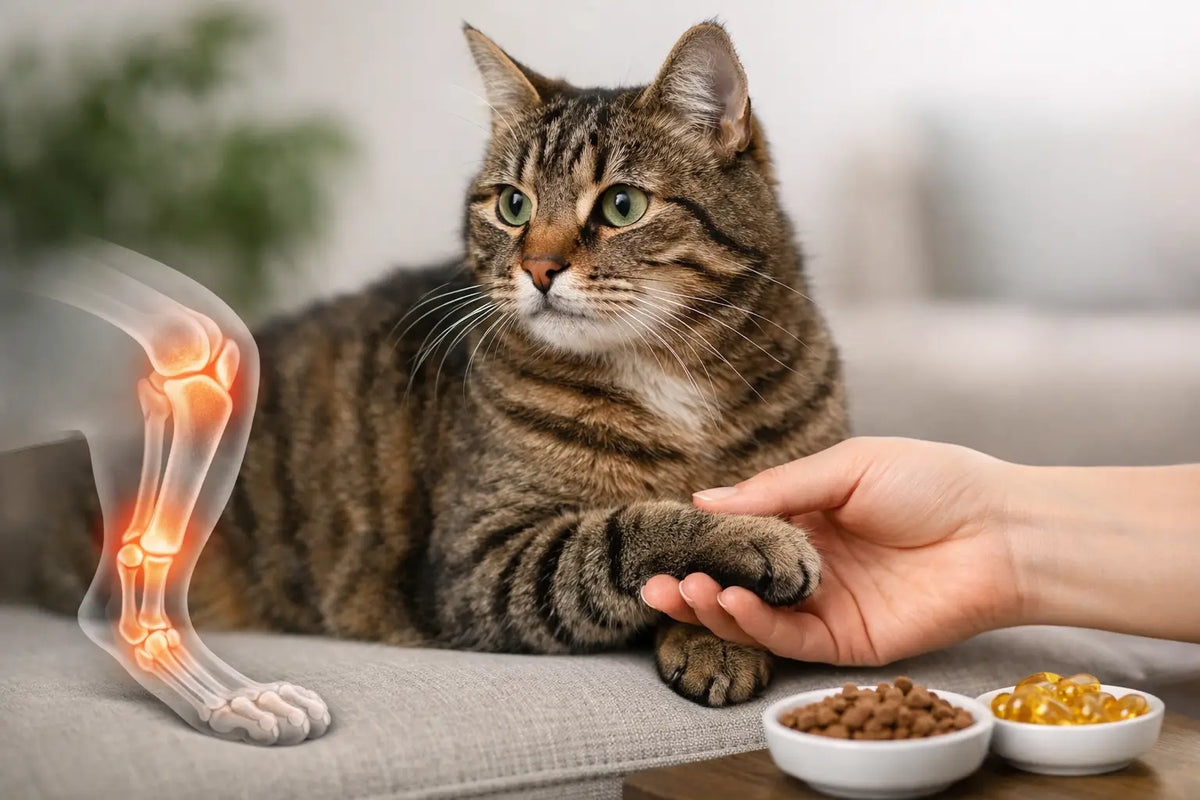
A cat does not stop jumping from one day to the next. More often, it changes its strategy: it hesitates in front of the sofa, chooses a lower chair, stays in its bed longer, or grooms its back less. This guide to joint support for adult cats begins precisely with those small but valuable signs, which deserve attention before reduced mobility affects the cat’s daily life.
An adult cat may live with stiffness and discomfort without displaying pain in the way a dog might. By instinct, it tends to hide vulnerability. Observing it carefully, managing its body weight, and working with your veterinarian on targeted nutritional support are practical steps to preserve comfort, independence, and the desire to move.
When a cat’s joints need attention
Aging is not the only reason a cat may move differently. Being overweight, inactivity, previous injuries, body structure, reduced muscle mass, and certain joint conditions can increase the load on the hips, knees, elbows, and spine. Even a five- or six-year-old cat that is inactive or overweight may benefit from a preventive assessment.
The signs that should not be dismissed as simple fussiness are often subtle. A cat that avoids shelves and windowsills, climbs down instead of jumping, struggles to use a high-sided litter box, or becomes irritable when picked up is communicating something. The same applies to a stiffer posture after resting, a less fluid gait, reduced grooming, or changes in appetite and play habits.
Not all of these behaviors indicate a joint problem. They may also be caused by dental, urinary, neurological, or general health disorders. That is why the first step is not to choose a supplement at random, but to arrange a veterinary examination, especially if the change is sudden, if the cat is limping, vocalizing, or stops eating.
Adult cat joint support guide: everyday essentials
The best support is not limited to a tablet or powder. It works when it includes small everyday choices that reduce unnecessary strain and respect the cat’s nature.
Body weight matters more than it may seem
Every extra kilogram increases the mechanical load on the joints and makes it harder to maintain effective muscle tone. An improvised diet is not the answer: the cat needs a ration calculated by the veterinarian, with measured food and treats included in the daily total. In cats, losing weight too quickly is risky, so the goal should be gradual and monitored.
A practical check involves observing the cat’s profile from above and gently feeling the ribs: they should be palpable without pressing firmly. This assessment does not replace the body condition score performed by a veterinarian, but it helps prevent weight gain over time from being overlooked.
Short, regular movement without forcing it
A stiff cat does not need intense workouts. It needs to move every day in a way that matches its abilities. Short sessions with a wand toy, lightweight balls, or games that encourage food searching can help keep muscles and coordination active without tiring the cat.
The environment makes an immediate difference. Steps or ramps to reach favorite spots, a litter box with a low entrance, non-slip rugs in walkways, and easy-to-reach bowls reduce avoidable jumps and twisting movements. If the cat likes being up high, there is no need to deprive it of its favorite spaces: make them accessible in stages.
Warmth, rest, and observation
A soft, stable bed away from drafts can provide relief for an animal that tends to stiffen after sleeping. Recording how often the cat jumps, plays, uses the litter box, and grooms itself for two or three weeks can also be very useful during a veterinary visit. Changes are easier to see by comparing habits rather than relying on memory.
Functional ingredients: what to really look for
When a veterinarian considers nutritional support appropriate, the quality of the formula and the consistency of its ingredients matter more than generic promises. A product intended for cats should be easy to administer, formulated for veterinary use, and included in a plan that takes diet, current medications, and health conditions into account.
Perna canaliculus, also known as the New Zealand green-lipped mussel, is a raw material used in mobility supplements because of its natural content of lipid compounds and structural components. Veterinary research has studied its use primarily in supporting joint function, although responses may vary according to species, formulation, and the animal’s condition. In cats, therefore, it is appropriate to consider it a complementary aid rather than a replacement treatment.
Boswellia serrata and devil’s claw are plant extracts traditionally used to support tissue well-being and the body’s normal response to joint stress. Precisely because they are active plant ingredients, they should not be treated as harmless in every circumstance: dosage, combinations, and suitability must be assessed by a veterinarian, particularly for cats with chronic conditions or concurrent treatments.
Spirulina, black carrot, beetroot, and orange carrot naturally provide pigments and micronutrients of nutritional interest. In a well-designed formula, they contribute to a more comprehensive approach without turning the product into a miraculous promise. The real benefit comes from consistency, suitability of the formulation, and attention to the cat’s individual health profile.
A targeted formula to support mobility and comfort
Artricur Pet by Aloeplus Cani e Gatti was developed to complement daily joint support with a selection of functional ingredients: Aloe arborescens, Perna canaliculus, black carrot, Spirulina, devil’s claw, Boswellia serrata, beetroot, and orange carrot. The presence of Aloe arborescens and carrot reflects the brand’s approach: enhancing natural raw materials through an HDR cold-processing method designed to preserve their characteristics.
It is not a solution that replaces diagnosis, prescribed medication, or weight management. It is a supplement designed for adult cats showing reduced flexibility of movement, senior animals that need consistent daily support, and cats that, in agreement with their veterinarian, may benefit from preventive attention to joint function.
The advantage of a multi-ingredient formula is its action across several aspects of joint well-being, but there is also a trade-off: not all cats have the same needs, and not all enjoy every format or flavor. For this reason, it is helpful to introduce any new supplement gradually, follow the administration instructions, and monitor appetite, stools, energy, and behavior during the first few days.
When veterinary care is needed without waiting
A supplement should not delay a clinical assessment. If the cat will not put weight on a leg, shows obvious pain, stops using the litter box, has recently suffered an injury, appears lethargic, or experiences unexplained weight loss, contact a veterinarian promptly. Even intermittent limping deserves further investigation: the fact that the cat starts walking again does not mean the cause has been resolved.
During the examination, the veterinarian can assess the joints, muscle tone, weight, pain, and mobility, determining whether further tests are needed. This step makes it possible to choose a realistic plan: sometimes adjusting the environment and diet is enough; in other cases, specific treatments are required, with nutritional support used alongside them.
Caring for an adult cat’s joints does not mean forcing it to behave like a kitten. It means giving it the conditions to continue doing what it loves: reaching its favorite spot, using the litter box comfortably, stretching in the sun, and seeking your company with confident steps.