
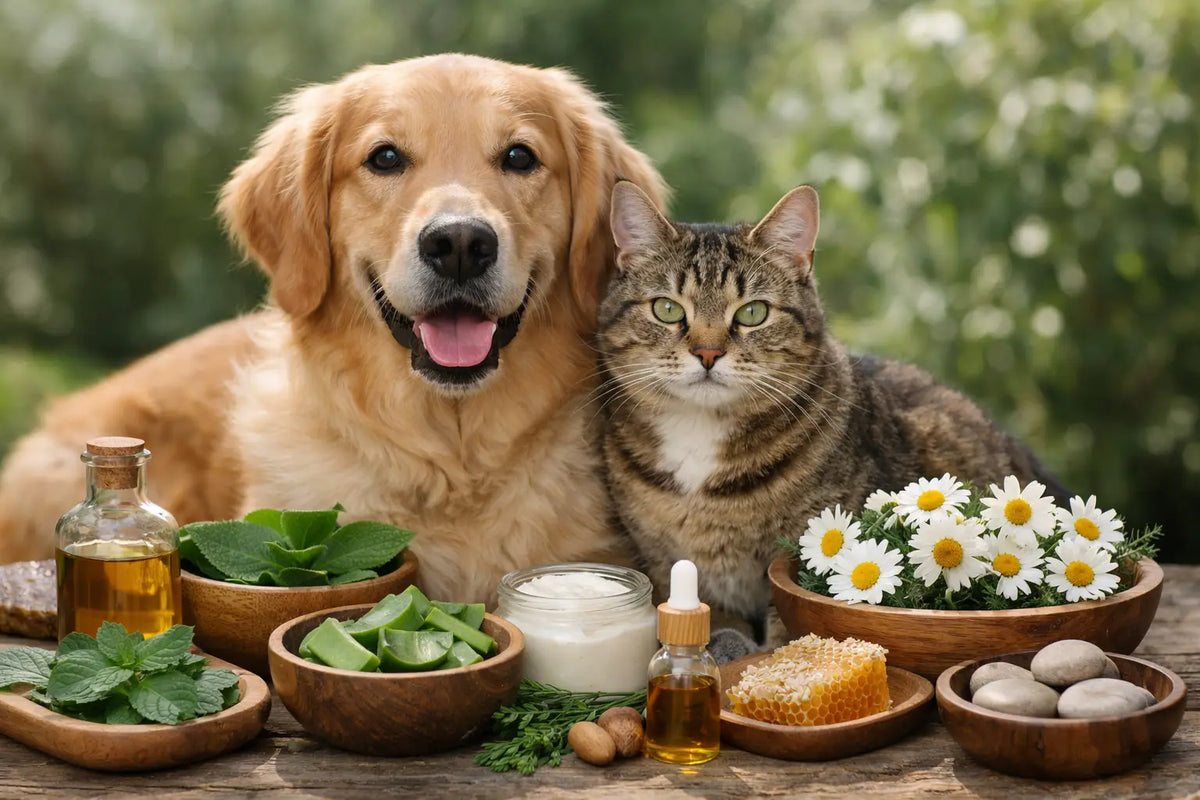
Itching that interrupts sleep, a coat that gets dirty more easily, a reddened area that the dog keeps licking: the skin is one of the first places where the animal’s well-being calls for attention. Choosing the best natural active ingredients for dogs’ and cats’ skin means using functional ingredients formulated to respect delicate skin, while carefully observing symptoms.
Not all irritations are the same, however. Dry skin may require nourishment and hydration, while a bad odor, persistent redness, dandruff, crusts, or intense itching warrant consultation with a veterinarian. Natural active ingredients provide concrete support for a dermofunctional routine, but they do not replace a diagnosis when the problem is recurring, widespread, or worsening.
Why dogs’ and cats’ skin becomes irritated easily
The skin barrier of dogs and cats is exposed every day to many different factors: bathing too frequently or with unsuitable products, saliva from licking, moisture between the toes, parasites, environmental allergens, contact with irritating surfaces, and seasonal changes. Even a minor alteration can cause discomfort: the animal scratches, nibbles at itself, or avoids contact in a specific area.
In dogs, the areas most often affected are the paws, skin folds, abdomen, armpits, and base of the tail. In cats, persistent licking can make the coat thin or dull and should always be interpreted cautiously: it is not necessarily just a skin problem, as it may also reflect pain, stress, or other disorders.
The most useful solution is not to conceal the sign with a generic product. It is to choose a formula that combines gentle cleansing, an emollient action, and targeted active ingredients, while monitoring the skin’s response over time.
The best natural active ingredients for sensitive skin
Aloe: hydration and localized comfort
Aloe is one of the most valued ingredients in skincare because of its composition rich in polysaccharides, substances that can help maintain surface hydration and provide comfort to skin exposed to dryness or redness. Scientific literature on Aloe vera has examined its soothing properties and its supportive role in the skin’s normal repair processes. In animal formulations, the quality of processing also matters, because treatment of the raw material affects the preservation of its functional components.
For pets, aloe is particularly useful when the skin appears dehydrated, stressed by external factors, or affected by localized discomfort. However, it should be used in products designed for veterinary use and for the specific application area: a formulation for paw pads does not have the same purpose as a gel for the coat or an ear cleanser.
Carrot: antioxidant support and better-protected skin
Carrot provides carotenoids, compounds known for their antioxidant role. In dermofunctional care, these elements are interesting because oxidative stress can contribute to making the skin less balanced and the coat less radiant. Carrot is not a miraculous solution for dermatitis or allergies, but when included in a well-designed formula, it complements the moisturizing and protective action of other active ingredients.
The combination of aloe and carrot is useful in the routine care of areas exposed to friction, dryness, and minor everyday discomforts. A localized gel can offer a practical solution after walks, contact with rough ground, or when a slight change in the skin’s appearance is noticed and needs to be monitored.
Calendula and propolis: allies for reactive skin
Calendula has traditionally been used in cosmetics for its softening and soothing action. Its extracts contain flavonoids and triterpenes, molecules studied for their antioxidant and calming effects on the skin. It is a sensible choice when the skin appears reactive and the aim is to promote a feeling of well-being without resorting to harsh cleansers.
Propolis complements this action well. It is a natural substance produced by bees and rich in phenolic compounds, valued in topical applications for its purifying properties. Research on propolis describes antimicrobial activity in vitro, but this does not justify considering it a treatment for skin infections: in the presence of discharge, a strong odor, pain, pustules, or lesions, veterinary evaluation is required.
Together, aloe, calendula, and propolis are particularly suitable for skin that needs to be cleansed and protected gently. They are also valuable active ingredients for caring for the most exposed areas, provided the product is formulated and tested for dogs and cats.
Urea, shea butter, and sweet almond oil for dry paws
When the problem is concentrated on paw pads, the nose, or calluses, the priority is to restore softness and flexibility. Urea is a naturally occurring component of the skin’s natural moisturizing factor and, at the appropriate concentrations, helps retain water in the skin’s surface layer. For this reason, it is useful in formulas designed for rough, dry areas.
Shea butter and sweet almond oil provide emollient lipids. They offer comfortable support against cold, hot asphalt, salt, sand, and abrasive surfaces. Vitamin E, thanks to its antioxidant function, helps protect the formula and completes the cosmetic maintenance treatment.
Consistency makes the difference here. Applying a moisturizing product only when the paw is already severely cracked may not be enough: a regular routine, especially during seasonal changes, helps keep the skin barrier in better condition.
Peppermint: freshness, but with care
Peppermint can provide a pleasant sensation of freshness on the skin and make applying a gel more comfortable in certain situations. However, it is an active ingredient that must be handled carefully: essential oils are not automatically harmless and must never be applied undiluted or mixed at home. In cats in particular, improper use of essential oils can be risky because of their metabolic sensitivity.
The correct choice is to rely exclusively on veterinary formulations with controlled dosages, following the recommended method and frequency of use. If the animal shows discomfort, drooling, redness, or persistently licks the product, it should be removed and advice should be sought from a veterinarian.
How to choose the right active ingredient for the problem
For reddened skin or mild itching, aloe, calendula, and propolis can provide a good soothing and purifying cosmetic base. If the skin is dry, rough, or exposed to external factors, a formula containing aloe, carrot, urea, and emollient lipids is more suitable. For localized areas requiring freshness and comfort, a gel with aloe, carrot, and peppermint may be useful, while always avoiding do-it-yourself preparations.
The product format also matters. A spray is convenient for the coat or hard-to-reach areas without handling the skin too much; a gel allows more precise application; a cream or balm is ideal for paw pads and very dry areas. The goal is not to use many products, but to use the one suited to the actual need.
A targeted solution for a skincare routine
Aloeplus Cani e Gatti has developed dermofunctional solutions that harness aloe and other selected natural active ingredients, using HDR cold processing designed to preserve the characteristics of the raw materials. Dermogel combines aloe, carrot, and peppermint for localized comfort; Dermospray combines aloe, calendula, propolis, and tea tree oil in a formula designed for skin hygiene. For paws and dry areas, Zampet combines aloe, carrot, urea, shea butter, sweet almond oil, and vitamin E.
Tea tree oil requires an important clarification: it must never be used undiluted on an animal or used in homemade preparations. In a veterinary product, its use must comply with the concentrations, instructions, and target species specified. For cats, before using any product containing essential oils, it is prudent to consult your veterinarian.
When natural ingredients are not enough and a veterinarian is needed
A quality natural active ingredient can support everyday well-being, but it should not delay a veterinary visit in the presence of deep wounds, bleeding, swelling, patchy hair loss, discharge, persistent bad odor, pain, or itching that does not improve. These signs may be caused by parasites, infections, allergies, endocrine disorders, or other conditions requiring a precise clinical course.
The best care begins with observation: look at where your dog or cat is experiencing discomfort, choose functional and safe ingredients for that area, and then assess changes day by day. More comfortable skin is not just a cosmetic matter: it is a small, tangible way to help your pet feel well at home, during every walk, and throughout every moment of rest.