
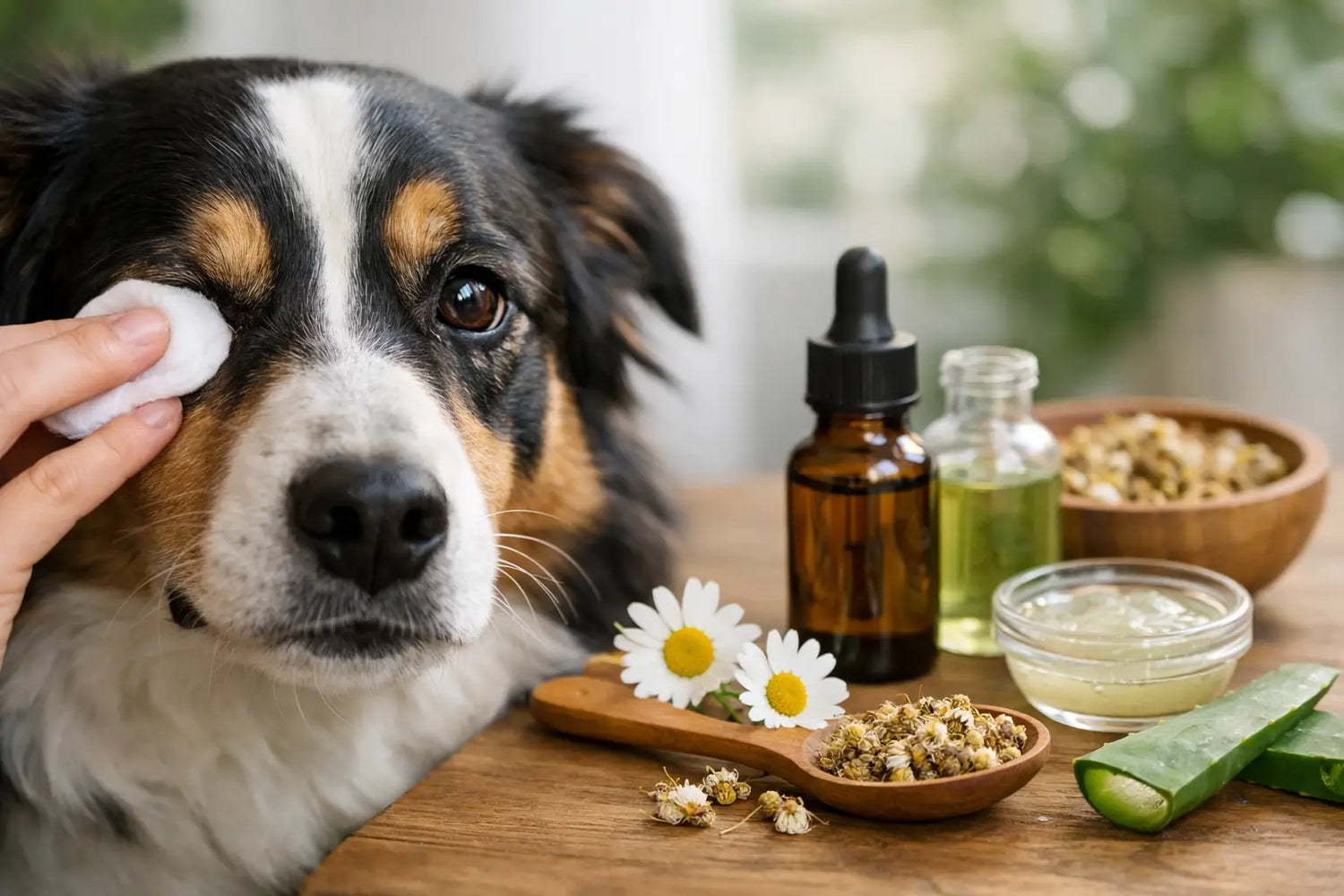
A dog's eyes change quickly. Just a walk in the wind, some dust, contact with tall grass, or slight sensitivity can lead to redness, tearing, or discharge at the corners of the eyes. When looking for the best natural remedies for a dog's eyes, the first rule is simple: act early, but gently, without improvising aggressive solutions on such a sensitive area.
When a natural remedy can really help
Not all eye discomforts are the same. There are mild, frequent situations in daily life where proper cleansing and soothing natural ingredients can make a real difference. Think of slightly red eyes after exposure to dust or wind, light discharge, slightly sticky eyelids upon waking, or the periocular area that tends to get dirty easily.
In these cases, a natural approach makes sense because it helps clean, refresh, and soothe the outer surface and eye contour, respecting the tissue’s balance. It’s different when there is obvious pain, a closed eye, yellow or green discharge, trauma, significant swelling, or corneal opacity. Here, home remedies are not enough and a quick veterinary evaluation is necessary.
This point matters more than any other. Natural does not mean suitable for everything. It means choosing what is gentle, well formulated, and consistent with the real problem.
Best natural remedies for a dog's eyes: which ingredients to look for
When it comes to eye health in dogs, the quality of the formula is crucial. It’s not enough for a product to “contain plant extracts.” It needs a combination aimed at cleansing without irritation and supporting local comfort.
Aloe for soothing and moisturizing action
Aloe is one of the most interesting ingredients for gentle cleansing of the eye contour. The reason is practical: it helps relieve stressed tissues and promotes a feeling of freshness, useful when the eye looks tired or the periocular area is red. In well-crafted formulations, aloe is valued precisely for its soothing profile.
Scientifically, interest in aloe for superficial tissues comes from the presence of polysaccharides and bioactive compounds studied for their contribution to maintaining hydration and protecting the skin-mucosa barrier. This does not authorize therapeutic shortcuts but explains why it is often chosen in quality eye cleansers.
Chamomile and cornflower for sensitive eyes
Chamomile is known for its calming effect, while cornflower is traditionally used in preparations dedicated to the eye area for its refreshing and soothing action. These two ingredients make sense when a dog has easily irritated eyes or tends to tear up due to environmental factors.
However, it should be said that homemade infusions are not the best choice. A chamomile tea prepared in the kitchen does not offer the same guarantees of purity, sterility, and stability as a veterinary formulation designed for local use. This is often where confusion arises between “natural” and “safe.”
Witch hazel for eye contour comfort
Witch hazel is another interesting active ingredient, especially when the problem concerns the eyelid margin or a dirty, stressed eye contour. In a correct formula, it can help keep the area clean, offering gentle support without weighing it down.
The useful aspect, for those living with a dog that easily gets dirty eyes, is the daily feeling of cleanliness that reduces buildup and crusting. This is not just an aesthetic detail: keeping the area clean also means limiting rubbing and discomfort.
Remedies to avoid, even if they seem harmless
Many owners look for an immediate solution and use remedies found online or recommended generically. This is understandable, but absolute caution is needed with a dog’s eyes.
Water alone can help rinse out a superficial foreign body in an emergency, but it does not represent a complete cleansing routine. Homemade chamomile, as mentioned, may contain residues or not be clean enough for such a delicate area. Essential oils, vinegar, baking soda, non-specific wipes, or products for human use should be excluded.
Even rough gauze or repeated gestures with excessive pressure can worsen irritation. When the eye is already sensitive, the difference between help and harm often lies in the gentleness of the product and the action.
How to clean a dog’s eyes correctly
Eye cleansing should be simple, quick, and low-stress. If it becomes a struggle, the dog stiffens and each cleaning becomes more difficult in the following days.
The best way is to use a specific solution for animal eye health, applying it on a soft gauze or following the product’s instructions. Start from the inner corner moving outward, with a gentle motion, without rubbing. If there is dry dirt, it’s better to soften it first and then remove it, rather than forcing it.
The frequency depends on the dog. Some dogs with short muzzles, protruding eyes, or a tendency to tear need more regular cleaning. Others only as needed. The point is not to clean a lot, but to clean well and consistently when necessary.
Best natural remedies for a dog's eyes: the practical solution for daily use
If the goal is to manage dirt, light tearing, and external sensitivity with a natural but serious approach, the choice of an eye cleanser formulated for dogs matters. A solution like Oftocur meets this need well because it combines aloe, chamomile, cornflower, and witch hazel in a formula designed for cleansing and soothing the eye area.
The advantage here is not only in the individual ingredients but in the balance of the formulation. Aloe supports the gentleness of the treatment, chamomile and cornflower help provide comfort to sensitive eyes, while witch hazel contributes to cleaning the eye contour. For those seeking a concrete natural remedy, the difference lies precisely in this: not relying on improvised ingredients, but on a ready, targeted solution suitable for the dog’s routine.
Within a specialized brand like Aloeplus Dogs and Cats, the added value is the creation of products based on real pet needs and a formulation culture focused on results. This reassures owners who want a natural response but without giving up serious quality standards.
When the problem is more than just dirt or mild irritation
There are signs that should never be normalized. If the dog keeps one eye closed, avoids light, scratches persistently, has thick discharge, or the cornea appears cloudy, the problem may be deeper. Corneal ulcers, infectious conjunctivitis, foreign bodies, marked allergies, or eyelid abnormalities require veterinary assessment.
Continuous tearing also deserves attention, especially in predisposed breeds. Sometimes the problem is not “dirty eyes” but chronic irritation due to conformation, hairs, eyelashes, or tear duct obstruction. In these cases, natural cleansing helps but does not replace diagnosis.
It’s right to say this clearly because trust is built this way too. The right product is useful when used in the right context.
Daily prevention: the real advantage of natural remedies
Many mild eye disorders are better managed by prevention than by chasing the problem. Keeping the periocular area clean, checking that no hairs rub the eye, cleansing after walks in dusty environments, and observing the color of discharges is already a concrete form of protection.
Natural remedies work well precisely here, in the routine. Not as a miraculous shortcut, but as constant support that reduces buildup, improves comfort, and helps the dog feel good every day. For those living with a sensitive animal, this continuity matters more than any sporadic intervention.
Tolerability also makes a difference. A well-formulated eye cleanser, used regularly, is easier for the dog to accept and simpler to integrate into the owner’s habits. And when a routine is sustainable, it lasts over time.
Taking care of a dog’s eyes means observing, cleaning thoughtfully, and knowing when to stop and seek veterinary advice. The best natural choice is not the most improvised one, but the one that respects the eye’s delicacy and your dog’s peace of mind.