
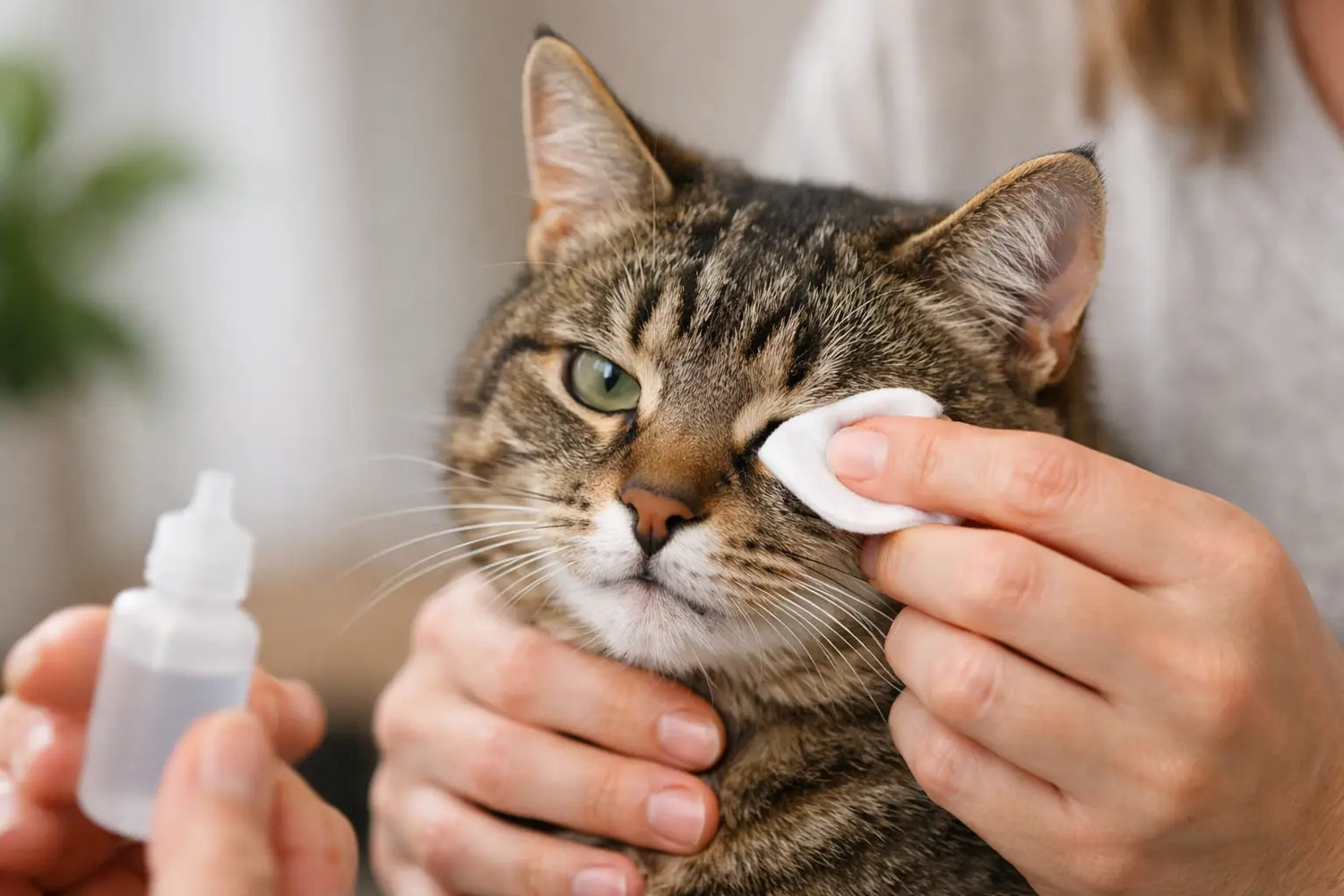
A cat that often rubs its face, has noticeable tearing, or small crusts at the corners of its eyes should not be ignored. Knowing how to clean a cat’s eyes correctly helps keep the eye area clean, reduce discomfort, and intervene before a simple discharge becomes a more serious problem.
The most common mistake is thinking that "just wiping with some water" is enough. A cat’s eyes are delicate, and for this reason, cleaning must be gentle, targeted, and done with suitable products. Proper cleaning not only removes dirt: it helps protect the mucous membrane, limit irritation, and support the animal’s daily well-being.
When it is really necessary to clean a cat’s eyes
Not all cats need the same routine. Some have minimal and occasional discharge, while others—due to facial structure, individual sensitivity, or contact with dust and allergens—tend to accumulate tearing and residues more easily.
A slight clear discharge upon waking can be normal. It is different when frequent crusts, redness, abundant tearing, wet fur under the eyes, or squinting appear. In these cases, cleaning is useful but should not replace clinical observation. If discomfort persists, the veterinarian remains the point of reference.
Brachycephalic breeds, such as Persians and Exotics, often require more attention. Their facial structure favors stagnation and accumulation, so regular cleaning can become part of the routine, always without excess.
How to clean a cat’s eyes step by step
Cleaning should be quick, gentle, and minimally stressful. Preparing everything beforehand is already half the work: soft sterile gauze and a specific ocular cleanser for animals are the safest choice.
Start when the cat is calm. Approach calmly, without restraining it abruptly. If the cat is wary, you can gently wrap it in a towel to make it feel secure and prevent sudden movements.
Moisten the gauze with the product and wipe from the inner corner outward with a single gentle motion. This point is important: do not rub back and forth, as you risk moving residues back onto the already cleaned area and further irritating the periocular surface. Use a different gauze for each eye.
If there are dry crusts, never forcibly remove them. It’s better to soften the secretion first by placing the moistened gauze for a few seconds, then gently remove it. When the deposit is stubborn, patience is needed, not pressure.
After cleaning, observe the cat’s response. If the eye looks cleaner and discomfort decreases, the routine was well tolerated. If you notice increasing irritation, thick discharge, or obvious pain, it’s time to stop and consult the veterinarian.
What never to use for ocular cleaning
Here a simple rule applies: if it is not designed for the pet’s eye area, it’s better to avoid it. Homemade chamomile, cotton wool that leaves fibers, scented wipes, pads with generic detergents, or human products can cause irritation or be unsuitable for the feline eye’s sensitivity.
Even water alone is not always the best solution. It can superficially remove dirt but does not offer the same gentleness as a cleanser formulated for veterinary ocular hygiene. Also, if used improperly or repeatedly, it may not solve the underlying cause of the accumulation.
Another common mistake is cleaning too often "just to be safe." If the eye is healthy and shows no significant discharge, excessive cleaning can be counterproductive. The right frequency depends on the cat’s predisposition and the specific situation.
The role of a specific ocular cleanser
When the periocular area tends to get dirty often, choosing a targeted product makes a difference. A good ocular cleanser for cats must clean without aggression, help remove secretions, and respect the mucous membrane’s balance.
In daily routines, formulations that enhance functional natural actives are particularly interesting. Ingredients like Aloe Arborescens and carrot, when included in a formulation designed for animal well-being, can offer concrete support thanks to their soothing, protective, and softening properties. Aloe Arborescens is appreciated for its gentle action on the skin and sensitive areas, while carrot is naturally rich in components useful for maintaining tissue health.
When these ingredients are processed with methods that preserve their functional profile, the result is a solution more consistent with the needs of those seeking a natural remedy but with a serious formulation base. This is exactly what attentive owners care about: not a generic promise, but practical support, well tolerated and designed for veterinary use.
How to tell if it’s just dirt or a problem to investigate
Cleaning is good, improvising a diagnosis is not. If the discharge is occasional and clear, cleaning may be enough. If it becomes yellowish, greenish, very abundant, or foul-smelling, it is a sign that requires attention.
The cat’s behavior also speaks clearly. If it avoids light, scratches persistently, keeps the eye closed, or appears bothered by the slightest touch, it is no longer just hygiene. The same applies if one eye looks different from the other or swelling appears.
In these cases, cleaning remains a supportive gesture but not a complete solution. A veterinary check is needed to understand if there are inflammations, foreign bodies, infections, or anatomical conditions that favor the problem.
How often to clean
There is no one-size-fits-all frequency. A cat without obvious discharge may hardly ever need it. A predisposed subject, however, may require daily or every-other-day cleaning.
The most useful rule is to observe the fur under the eyes and the eyelid margin’s appearance. If the area stays dry and clean, there is no need to intervene too much. If residues form, regular treatment helps avoid buildup and irritation from stagnation.
Consistency matters more than intensity. Better a gentle, well-done cleaning with the right product than sporadic but aggressive interventions.
The advantage of a natural solution but formulated with care
Anyone living with a cat knows: everything concerning eyes, ears, and skin must work without causing additional stress. For this reason, veterinary dermofunctional formulations have a precise role. They combine sensitivity to natural ingredients with a technical approach focused on results.
In the case of ocular cleansing, a formula based on Aloe Arborescens and carrot can help clean, soothe, and protect a very exposed area. If behind it there is also a processing method designed to preserve active principles, like the cold HDR method developed by Aloeplus Cani e Gatti, the added value is concrete: greater attention to raw material quality and its functional yield in the finished product.
This approach appeals to those seeking a natural remedy but who do not want to rely on DIY. And it makes sense: a cat’s eyes do not ask for trials, they ask for precision.
A small gesture that improves daily well-being
Cleaning a cat’s eyes is not just an aesthetic matter. It means preventing buildup, reducing discomfort, and noticing immediately if something changes. It only takes a few minutes, but done well.
If your cat tends to have frequent discharge or a sensitive periocular area, choosing a specific ocular cleanser, gentle and formulated with functional natural actives, can make the routine easier and more effective. The difference is often seen in the details: fewer crusts, less discomfort, more comfort every day.
When you observe carefully and intervene with the right product, daily care stops being a problem and becomes a concrete form of protection.