
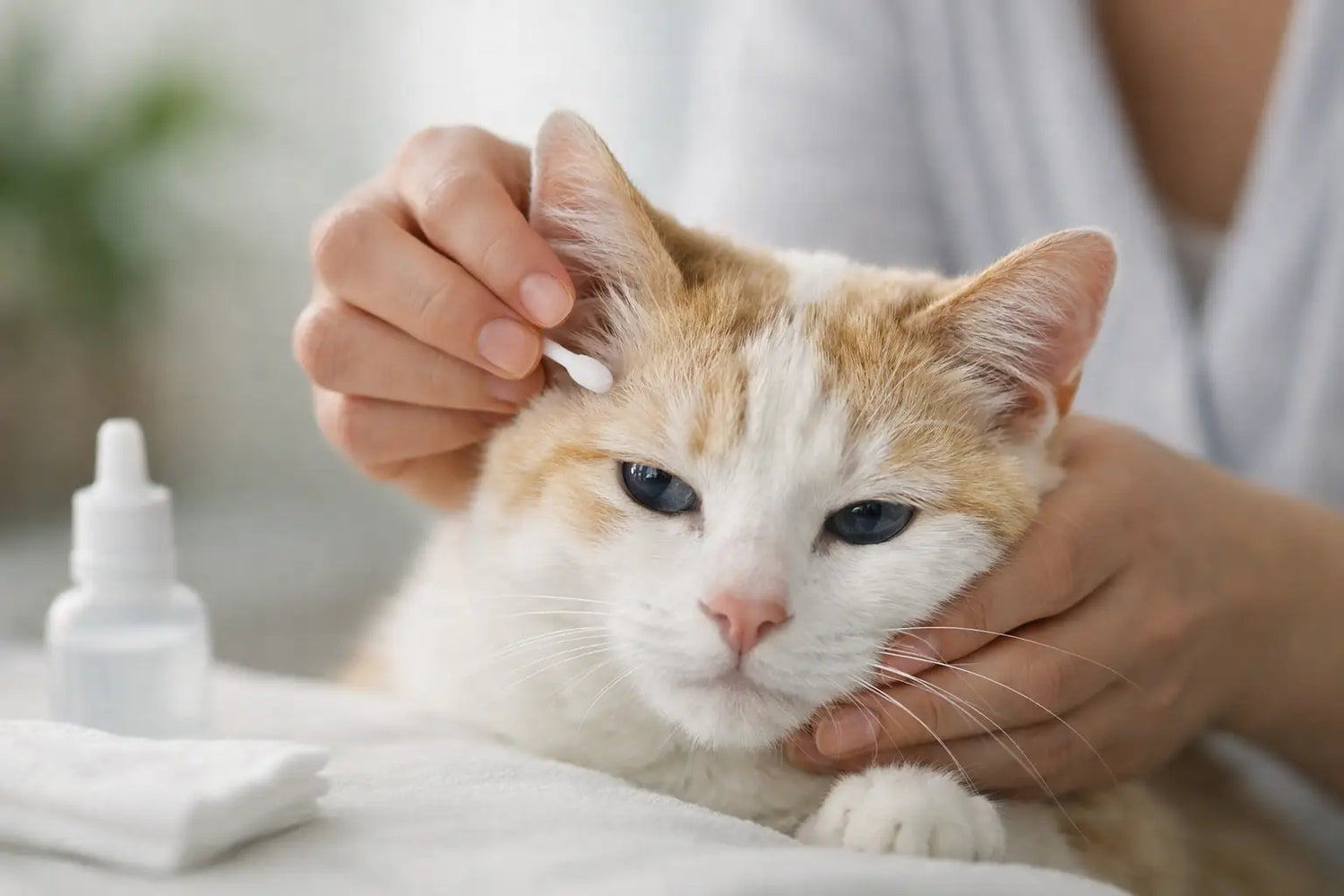
If your cat shakes its head, often scratches near its ears, or stiffens as soon as you try to touch them, understanding how to clean sensitive cat ears properly becomes a matter of daily well-being, not just hygiene. In these cases, the difference is made by the gentleness of the action, the choice of cleanser, and the ability to recognize when to stop and seek a veterinarian's advice.
When cat ears really need cleaning
Cat ears should not be cleaned automatically or too frequently. A healthy ear tends to self-regulate, and if there is no excess wax, bad odor, or obvious dirt, intervening too often can disrupt the local balance and make the ear flap even more reactive.
The situation changes when the cat has sensitive ears, produces more wax than usual, or shows signs such as mild redness, discomfort to touch, superficial secretions, or unpleasant odor. In these cases, a well-done ear cleaning can help reduce the buildup of impurities and keep the ear environment cleaner and more comfortable.
However, there is an essential distinction: cleaning does not mean treating. If you notice very abundant dark secretions, pain, swelling, lesions, a tilted head, or the cat reacts strongly, it is not the time for DIY. A veterinary evaluation is needed to rule out ear infections, ear mites, dermatitis, or foreign bodies.
How to clean sensitive cat ears without stressing them
When the cat is delicate or wary, technique matters as much as the product. The ideal moment is when it is calm, perhaps after resting or being petted. Forcing it only increases tension and defense.
Prepare everything beforehand: soft gauze or a non-fraying pad and a specific ear cleanser for animals. Avoid cotton swabs, home remedies, alcohol, hydrogen peroxide, or cleansers not formulated for cat ears. These choices can irritate, push dirt deeper, or alter the skin.
Gently lift the ear flap and observe the inside. If you only see superficial dirt, you can apply the cleanser according to the product instructions and very gently massage the base of the ear for a few seconds. This helps soften the wax and encourages it to rise to the outside. Then remove only what appears on the visible part, never going deep inside.
With a sensitive cat, a short and well-tolerated cleaning is better than a persistent maneuver. If it struggles after a few seconds, stop and try again at a better time. Gentle, regular care is often more effective than a vigorous cleaning done rarely.
Errors that worsen ear sensitivity
Many discomforts arise from good intentions done poorly. The first mistake is cleaning too often. If the ear doesn’t need it, the skin can become drier, more irritable, and prone to inflammation.
The second mistake is using harsh or non-specific products. A formula that is too degreasing or rich in irritating substances can increase itching instead of reducing it. Also, the habit of rubbing vigorously with gauze or tissues is counterproductive, especially in cats with reactive skin.
The third mistake is ignoring warning signs thinking that better cleaning is enough. If the problem is inflammatory or parasitic, simple cleaning does not solve the cause.
Which cleanser to choose for a cat with sensitive ears
A delicate cat needs an ear cleanser designed to respect the local physiology. The ideal formula should clean without aggression, help remove excess wax, and offer a soothing action on skin exposed to itching and redness.
In this context, well-selected natural ingredients have real value. Aloe is appreciated for its film-forming, moisturizing, and soothing properties on skin and superficial mucous membranes. Scientific literature has described, in various dermatological contexts, aloe vera’s potential to support skin repair processes and promote local comfort, although results depend on formulation and concentration.
Calendula is traditionally used for its soothing effect on irritated skin, while propolis is studied for its antimicrobial and protective properties thanks to its content of phenolic compounds and flavonoids. Coconut oil, due to its lipid component, can also help soften residues and support the skin barrier. Tea tree oil deserves a note of caution: it can be useful in properly dosed veterinary formulations but should never be used pure or in improvised preparations, as cats are very sensitive to many essential oils.
For this reason, it makes sense to choose a veterinary product already balanced, where active ingredients are included in a formula designed for the pet’s ear and not for general use.
Ear cleaning and natural ingredients: why the formula matters
When talking about sensitive ears, saying “natural” is not enough. What matters is how ingredients are selected, combined, and processed. A formula can be rich in plant extracts but poorly tolerated if it is not designed for a delicate area like the external ear canal.
An ear cleanser with aloe, calendula, propolis, coconut oil, and tea tree oil, if formulated for veterinary use, meets three practical needs well: cleaning wax without excessive aggression, helping keep the skin calmer, and helping counteract that “dirty ear” feeling often accompanied by odor and discomfort. This approach is especially useful for cats prone to secretion buildup or that poorly tolerate stronger cleansers.
In the case of Otorì ear cleanser, the presence of these natural actives goes exactly in this direction: combining cleanliness and gentleness, with a formula designed for the daily ear hygiene of sensitive pets. Aloe helps provide relief, calendula and propolis support skin protection, while coconut oil and tea tree oil contribute to functional ear cleaning. For those seeking a practical solution consistent with a natural and specialized approach, it is a concrete answer.
How often to clean the ears
The frequency depends on the individual cat. Some almost never require cleaning. Others, especially if they produce more wax or are prone to local irritations, can benefit from regular checks and more frequent, but always thoughtful, cleanings.
Practically, it makes sense to observe before intervening. If the ear looks clean, pink, odorless, and the cat shows no discomfort, often nothing needs to be done. If you notice mild but recurring buildup, periodic cleaning with a gentle product can help maintain balance and prevent worsening.
When cleaning is not enough
Sometimes the owner looks for the right cleanser, but the underlying problem is something else. A cat with allergies, dermatitis, mites, or ear infection may have sensitive ears as a sign of a broader condition. In these cases, even the best cleanser should be considered a support, not the sole solution.
The same applies when wax changes appearance, becomes very dark, abundant, or foul-smelling. Or when the cat scratches until it injures itself, shakes its head continuously, or doesn’t even allow a touch. Here, diagnosis is the priority.
A serious approach to the cat’s ear well-being always starts from this balance: targeted hygiene where needed, constant observation, and clinical attention when signs are not just simple dirt buildup.
How to make cleaning easier over time
With sensitive cats, the routine is built gradually. Don’t wait until the ear is very dirty to start getting it used to contact. Accustom it with small gestures: touch the ear flap, lift it for a second, reward calmness. When the time for real cleaning comes, it will perceive it as less invasive.
Your calmness also has a direct effect. Quick movements, tense voice, and repeated attempts send alarm signals. Slow and confident handling helps the cat not go into defense. If necessary, split the procedure into two moments, one ear at a time.
Knowing how to clean sensitive cat ears means above all respecting a delicate balance: cleaning when needed, doing it with correct gestures, and relying on specific formulas that combine effectiveness and tolerability. When the product is well designed and the routine is gentle, ear hygiene stops being a struggle and becomes a care gesture your cat can accept much more peacefully.