
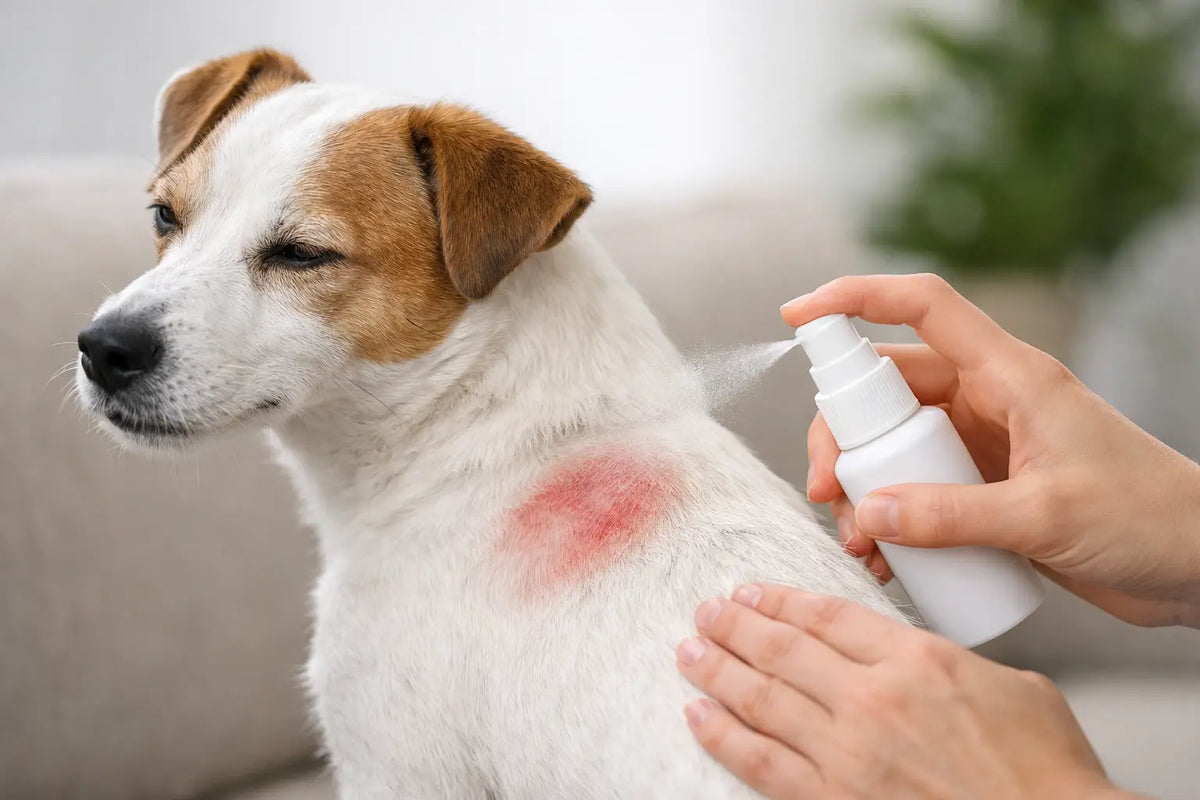
Itching that keeps your dog awake, a reddened area between the toes, or a dog that keeps licking the same spot deserves immediate attention. Knowing how to use Dermospray for dogs correctly helps care for irritated skin with a simple, targeted gesture that respects its sensitivity. The fundamental rule is this: a topical product can provide valuable daily support, but it does not replace a veterinary diagnosis when the discomfort persists, worsens, or is accompanied by significant lesions.
When to use Dermospray on your dog
A dog’s skin is exposed every day to mud, grass, moisture, dust, parasites, and minor injuries from play. Some dogs, especially those with delicate skin, thick coats, or a predisposition to allergies, may develop localized redness, itching, bad-smelling skin, dry skin, or a tendency to lick themselves persistently.
Dermospray is designed for localized skin hygiene and well-being, especially when it is practical to treat areas that are difficult to reach with a cream. It can be useful, for example, after a walk in the countryside, in cases of superficial irritation without bleeding, in skin folds, on the paws and between the paw pads, or when the coat makes applying thicker products inconvenient.
The spray consistency makes it possible to reach the skin without rubbing forcefully. This detail matters: an area that itches or burns can become even more sensitive if it is handled too much. Before applying any product, however, examine the area carefully. If you notice deep wounds, pus, extensive scabs, swelling, obvious pain, patchy hair loss, or a strong odor, contact your veterinarian.
What Dermospray contains and why the formula is targeted
Dermospray’s formula combines Aloe, calendula, propolis, and tea tree oil. These ingredients were selected to support the skin’s normal barrier function and promote a feeling of comfort in skin exposed to external stress.
Aloe is valued in cosmetic dermatology for its polysaccharide components and its emollient and moisturizing action. A review published in the Journal of Clinical and Aesthetic Dermatology highlighted aloe’s potential to support hydration and skin repair processes, while also noting that its effectiveness and indications depend on the type of formulation and the condition being treated. In dogs, this makes it an interesting ingredient for caring for dry or reddened skin, without assigning it the role of a drug.
Calendula has traditionally been used for its soothing and emollient properties. Its compounds, including flavonoids and triterpenes, are being studied for their antioxidant and calming activity at skin level. Propolis, which is rich in phenolic compounds, completes the formula with a purifying and protective contribution. Tea tree oil, however, requires an important clarification: it should never be used experimentally or applied pure to an animal. In a product formulated for veterinary use and used as directed, it is present at a carefully studied concentration within the formula; it remains essential to prevent the dog from licking the treated area immediately and to discontinue use if irritation appears.
It is precisely the balance of the formula that makes the difference. Using essential oils, human creams, or home remedies on a dog’s skin without knowing their concentrations and contraindications can make the problem worse. For the animal’s well-being, specific formulations and a considered routine are needed.
How to use Dermospray for dogs: correct application
Application takes only a few minutes, but it should be carried out carefully. Choose a calm moment, especially if your dog tends to become nervous when its paws, belly, or outer ears are touched.
1. Gently clean the area with clean gauze or a soft cloth, removing dirt, residue, and moisture. Do not rub damaged or very painful skin.
2. Dry the coat and skin thoroughly. Moisture trapped in folds, between the toes, or beneath a thick coat can contribute to maceration and bad odors.
3. Shake the bottle and spray Dermospray onto the affected area, keeping a sufficient distance to prevent the spray from frightening your dog. If the area is small or your dog is sensitive to noise, spray it onto gauze first and gently dab the area.
4. Allow it to dry without rinsing, and distract your dog for a few minutes with a short walk, quiet play, or a scent-based activity to limit immediate licking.
Always follow the instructions and frequency stated on the label. Increasing applications in an attempt to speed up the result is not a good strategy: the skin needs consistency, not excess. If the problem is mild and related to an occasional event, the product can become part of a localized care routine. If the irritation keeps returning, however, it is worth investigating the cause with your veterinarian: environmental allergies, fleas, diet, contact dermatitis, infection, or pain can cause a dog to scratch and lick itself.
Areas requiring extra attention
The paws are among the areas most exposed to irritation. After rain, mud, or long walks on hot asphalt, check the paw pads and spaces between the toes. Look for foreign objects, cuts, grass awns, or redness: the spray can help maintain skin hygiene, but it will not remove an embedded grass awn or resolve a deep lesion.
The belly, armpits, and skin folds also deserve attention, because heat and moisture tend to accumulate there. In dogs with facial wrinkles or abundant skin, thorough drying is as much a part of prevention as the product selected. Avoid the eyes, mucous membranes, inner ear, and genitals unless specifically instructed otherwise by your veterinarian.
Common mistakes to avoid
The first mistake is treating itching as merely a cosmetic problem. Repeated scratching can damage the skin barrier and turn an initial irritation into a cycle that is difficult to stop. The second is applying the spray to a dirty or wet area: this reduces contact with the skin and can trap moisture.
Also be careful when combining multiple products. Medicated shampoos, spot-on parasite treatments, veterinary creams, and cleansers require consistent management. If your dog is already receiving dermatological treatment, ask your veterinarian whether and how to incorporate a topical product. Extra caution is needed in puppies, older dogs, pregnant females, and animals with a history of skin reactions.
Before the first use, especially with sensitive dogs, you can apply a small amount to a limited area and observe the response. If increased redness, swelling, restlessness, more intense itching, or other unusual signs appear, discontinue use and ask your veterinarian for advice.
Daily care begins with observation
Dermospray by Aloeplus Cani e Gatti offers a practical solution when the skin needs localized attention: a formula containing Aloe, calendula, propolis, and tea tree oil that is easy to apply even to more difficult areas. The best results, however, come from combining the product with regular cleaning and observation of your dog.
Checking your dog’s paws, belly, and coat every day does not mean worrying excessively. It means noticing changes early, responding with appropriate care, and recognizing when veterinary support becomes necessary. For those who consider their dog a member of the family, this is the most practical form of protection.