
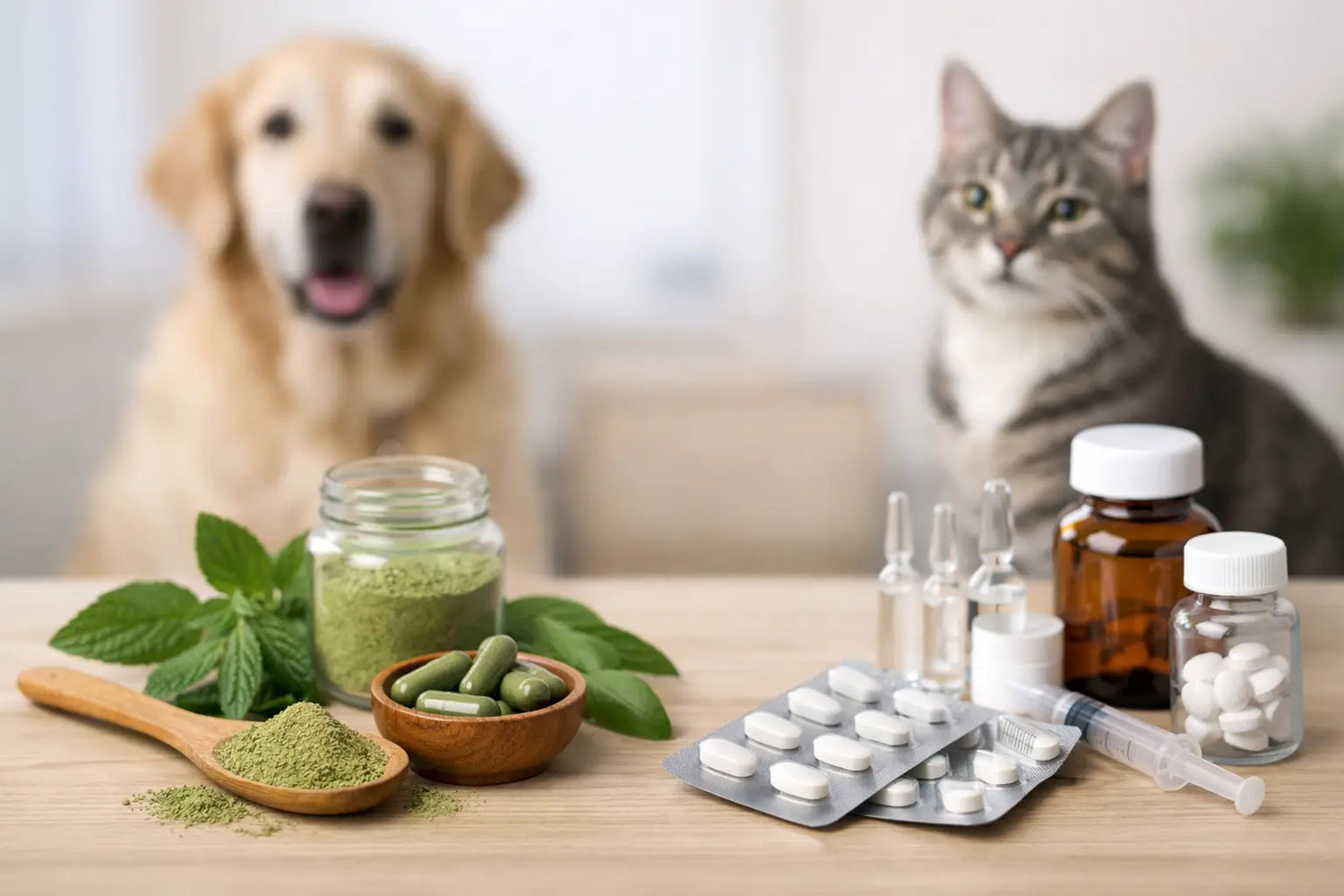
When a dog has been scratching for days, a cat eats less, or an elderly animal struggles to get up, the question immediately arises: veterinary nutraceutical or medicine? It’s a valid doubt because choosing well means truly helping the animal without wasting precious time. But the answer is never a slogan: it depends on the problem, its severity, the diagnosis, and the treatment goal.
Veterinary nutraceutical or medicine: the real difference
The key point is this: a veterinary medicine is designed to prevent, treat, or cure a disease with a defined action, precise dosage, and approved therapeutic indications. A veterinary nutraceutical, on the other hand, works by supporting the functional health of the body. It does not replace medicine when therapy is needed but can assist in managing the problem or intervene in the early stages, maintenance, and prevention.
For those who live daily with dogs and cats, the difference is clear in practice. If there is a bacterial ear infection, a nutraceutical or functional cleanser alone is not enough. But if there is a tendency to earwax buildup, bad odor, ear sensitivity, or recurrences caused by poor local hygiene, a well-formulated dermofunctional support can become part of a useful routine to protect the balance of the ear flap and external ear canal.
This distinction also applies to joints, skin, liver, eyes, and paw pads. Medicine is used when there is a pathology to be treated specifically. Nutraceuticals come into play when we want to support a function, improve comfort, help the body’s natural response mechanisms, or accompany a therapeutic path decided by the veterinarian.
When medicine is the right choice
There are situations where waiting or trying only a natural approach is a mistake. Acute pain, fever, infections, serious wounds, eye injuries, painful ear infections, persistent vomiting, organ failure, severe allergies, or diagnosed diseases require a veterinary visit and often pharmacological therapy.
The value of medicine lies in its therapeutic strength and the speed with which it can act on specific pathological processes. However, this does not mean it is always the only answer for everything and forever. In many chronic or recurring conditions, the issue is not only to suppress the symptom at its worst but also to work on the biological environment that favors the disorder.
Think about joints. A dog with severe pain may need medicine to control the acute phase. But then there is the issue of long-term support for cartilage, mobility, inflammatory response, and quality of life. This is where targeted nutraceutical formulations come into play, if chosen wisely.
When veterinary nutraceuticals really make sense
Veterinary nutraceuticals are useful when the goal is to support a physiological function continuously and safely, especially in disorders that tend to recur or worsen slowly. It is not a shortcut, nor medicine disguised as natural. It is a different tool, with a different logic.
In joint health, ingredients like Perna canaliculus, Boswellia serrata, and Devil’s claw are studied for their role in supporting osteoarticular well-being and modulating the inflammatory response. In a product like Artricur Pet, these actives combine with Aloe arborescens, spirulina, black carrot, beetroot, and orange carrot in a formula aimed at daily support for dogs and cats showing stiffness, movement difficulties, or needing to maintain good joint comfort with age.
Liver support is another area where nutraceuticals find a place. The liver is involved in many metabolic functions, and when the veterinarian identifies a need for support, substances like milk thistle with high silimarin content, betaine, zinc, B vitamins, and resveratrol can be rational choices. Scientific literature has explored the hepatoprotective role of silimarin and betaine in liver metabolism in various contexts. In a supplement like Epapet, these components are selected precisely to offer targeted functional support.
The discussion is similar for skin and mucous membranes. Mild redness, easily dry skin, cracked paw pads, or stressed skin areas can benefit from ingredients with soothing, moisturizing, and protective actions. Aloe, calendula, propolis, shea butter, sweet almond oil, chamomile, cornflower, and witch hazel are well-known ingredients for their topical use in skin wellness and gentle cleansing. If the problem is functional and not strictly pathological, the quality of the formula makes the difference.
The critical point: natural does not always mean sufficient
Those who love natural remedies often make a good-faith mistake: thinking that natural means suitable for every situation. It’s not so. A good veterinary nutraceutical should be chosen because it has a sensible composition, functional actives consistent with the problem, and a clear usage profile. Not just because “it can’t hurt.”
The opposite is also true: medicine is not necessarily a choice to fear. If the veterinarian prescribes it, it is because at that clinical stage it is the correct tool. The right question is not which of the two is better overall, but which is more useful now for this dog or this cat.
For this reason, the opposition between veterinary nutraceutical or medicine is often misleading. In modern veterinary medicine, the approach is much more often about intelligent integration. Therapy when needed, functional support when useful, and ongoing monitoring always.
Veterinary nutraceutical or medicine in the most common problems
Joints and mobility
If a dog suddenly limps or a cat shows obvious pain, a veterinary evaluation is needed. But if the problem is progressive stiffness, slower motor recovery, less desire to jump or climb stairs, a joint nutraceutical can be a concrete long-term choice. In these cases, complete formulas work well, not isolated ingredients randomly combined.
Liver and metabolism
After therapies, metabolic stress, or when parameters suggest liver support, the veterinarian may recommend or add a nutraceutical support. Here, the quality of raw materials and standardization of actives, such as standardized milk thistle, are very important.
Ears, eyes, and skin
If there are abnormal secretions, pain, ulcers, infections, or severe itching, medicine may be indispensable. But in the daily management of delicate eyes, ears prone to buildup, or reactive skin, well-formulated dermofunctional products help reduce conditions that favor discomfort. Aloe, calendula, propolis, chamomile, and tea tree oil are ingredients that, when used in the right formulations and contexts, can support cleanliness, protection, and local well-being.
Paws and pads
Cracked paw pads rarely require medicine but need constant care. A formula with aloe, carrot, urea, shea butter, sweet almond oil, and vitamin E works on hydration, softness, and protection of the skin barrier—key aspects for active dogs or those exposed to harsh surfaces.
How to choose without being guided only by marketing
A careful owner should ask three questions. First: is there a veterinary diagnosis or just a suspicion? Second: is the problem acute, chronic, or recurring? Third: am I looking for therapy or functional support?
Then comes product quality. A serious formula does not just evoke nature. It must declare consistent ingredients, have a logical use, and fit into a realistic approach to pet wellness. When a formulation enhances actives like Aloe Arborescens and carrot through processes designed to preserve their functional components, the advantage is not theoretical: it is linked to the possibility of offering a more intact support closer to the original value of the raw material.
In this sense, Aloeplus Dogs and Cats’ approach aims precisely to bridge the gap between naturalness and formulation rigor, with targeted products for specific needs of dogs and cats, from mobility to skin, from ear hygiene to eye wellness, up to metabolic support.
The best choice is often to combine expertise and continuity
Anyone living with an animal knows well: many problems don’t start with an emergency but with small signs. A different smell from the ears, a paw licked more than usual, a jump avoided, a less shiny coat. Early intervention, with the right support, can make a big difference in daily comfort.
For this reason, the most useful criterion is not to take sides between natural and pharmaceutical. It is to learn to recognize when to treat and when to support. Medicine treats disease when a therapeutic response is needed. Nutraceuticals accompany, protect, and help the body maintain its balance, especially over time.
If you look at your dog or cat and feel something is wrong, don’t look for an ideological answer. Look for the one best suited to their real need, with the veterinarian as a reference and quality formulas as allies in daily care.