
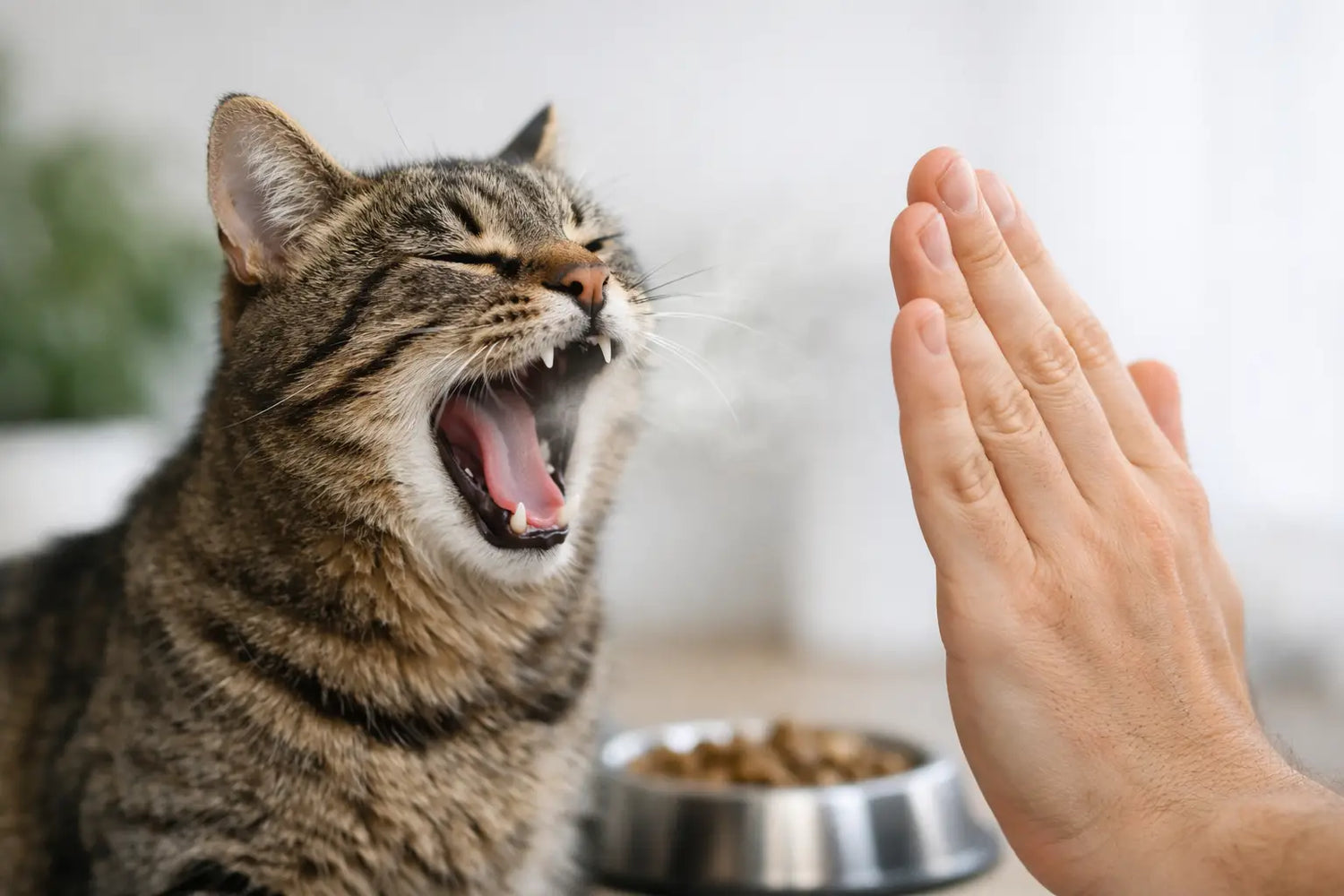
If you are wondering why your cat has bad breath, the first thing to know is this: it is almost never just a simple detail. An unpleasant smell from your kitty’s mouth can be a sign of a very common oral problem, but sometimes it also signals deeper issues that deserve veterinary attention.
Many owners notice it during cuddles, when the cat yawns or gets close to the face. At first, it’s easy to think it’s normal. In reality, truly bad breath should not be considered physiological. Understanding where the problem comes from allows you to intervene earlier, more effectively, and with less stress for the animal.
Why does the cat have bad breath: the most common causes
In most cases, the cat’s halitosis starts in the mouth. Plaque, tartar, and gum inflammation are among the most common causes. Food residues and bacteria accumulate on the teeth, especially if oral hygiene is absent or difficult to manage at home. Over time, this buildup mineralizes and becomes tartar, creating an environment favorable to inflammation, pain, and bad odor.
Another frequent cause is stomatitis, an inflammatory condition of the oral cavity that can be particularly uncomfortable in cats. The kitty may eat less, chew on only one side, drool more, or suddenly become irritable when its muzzle is touched. In these cases, bad breath is not the main problem but the most obvious symptom of real discomfort.
There are also situations where the mouth odor changes due to systemic reasons. Some kidney diseases can cause breath with a more ammonia-like smell. Diabetes can be associated with a sweeter or acetone-like odor. Gastrointestinal problems, an unsuitable diet, or ingestion of foul-smelling substances can also contribute, but much less often than commonly thought.
When the cat’s bad breath should not be underestimated
Not all cases have the same urgency. If the bad smell has appeared recently but the cat eats, plays, and shows no other signs, it is still useful to schedule an oral check-up. However, if halitosis is accompanied by red gums, bleeding, difficulty eating, weight loss, excessive drooling, or refusal of dry food, the visit should be sooner.
An important point is age. Dental problems are very common in adult and senior cats. Several scientific studies and veterinary clinical practice confirm that periodontal disease and gingivitis are frequent conditions in the feline population, often underdiagnosed in the early stages. This explains why many cats are seen when the discomfort is already advanced.
The odor can also give a clue, although it does not replace a diagnosis. A putrid breath more easily suggests plaque, tartar, or oral infection. A metallic smell can appear in the presence of gum bleeding. An unusual and persistent odor, especially if different from usual, always deserves attention.
What happens inside the cat’s mouth
The cat’s mouth is a delicate environment. When the balance of the oral microbiota is disturbed, bacteria proliferate and produce volatile sulfur compounds responsible for bad odor. It is the same mechanism observed in other species, but in cats, it can progress quickly if not treated.
Moreover, gum inflammation does not always remain localized. A painful mouth changes the way the cat chews, grooms, and feeds. Some start eating fewer kibbles and prefer only soft textures. Others stop licking themselves regularly. The result is a general worsening of well-being, even when the problem started from a simple plaque buildup.
Why the cat has bad breath even if it eats normally
This is a very common question. The fact that the cat continues to eat does not exclude an oral problem. Cats tend to mask pain well and often change their habits almost invisibly. They eat more slowly, choose small bites, tilt their head, or avoid certain foods, but without stopping completely.
For this reason, daily observation is very important. If you notice the cat grooming less, having a more neglected coat, chewing cautiously, or moving away from the bowl after a few bites, it’s worth investigating. Bad breath alone is already a useful signal. Combined with small behavior changes, it becomes even more significant.
How to help a cat with halitosis
Treatment depends on the cause. If there is significant tartar, the veterinarian may recommend professional dental cleaning. If there is stomatitis or a systemic disease, a more comprehensive evaluation will be needed. Therefore, there is no one-size-fits-all solution.
What really makes a difference, especially in early cases or as ongoing support, is proper oral hygiene combined with gentle, well-tolerated products designed for the cat’s oral cavity. The goal is not to mask the odor but to reduce the factors that cause it: bacterial load, inflammation, residue buildup, and tissue irritation.
In this context, natural ingredients with soothing and protective action can be a concrete help. Aloe Arborescens is particularly interesting for its functional profile. In the literature, aloe is studied for its emollient, soothing, and tissue-supporting properties, with applications that also include oral cavity well-being. When processed correctly, preserving active principles, it can help maintain a more balanced mucosa less prone to irritation.
Carrot, rich in antioxidant compounds, also fits well into a natural support strategy. The rationale is simple: a stressed or inflamed oral mucosa benefits from a more protected environment, while a consistent routine helps limit worsening of the condition.
Natural support for daily oral hygiene
When the problem is oral, consistency is more important than occasional interventions. A support formulated for mouth well-being can help the owner better manage the daily phase between veterinary check-ups. This is where a specific solution, designed for pet use and not improvised with home remedies, makes the most sense.
Aloeplus Cani e Gatti offers Oralpet, a support dedicated to oral hygiene and oral cavity well-being for dogs and cats, formulated with Aloe Arborescens and carrot and enhanced by the HDR cold processing method, developed to preserve the active principles of raw materials. In a cat with bad breath related to plaque, gum irritation, or poor oral hygiene, a product like this can fit well into a regular routine, with a gentle but effective approach.
The point is not to promise miracles. If there are lesions, significant infections, or marked pain, a veterinarian is needed. But in cases where the problem arises or persists due to insufficient oral hygiene, using functional and well-selected natural ingredients can make a real difference in daily management.
What not to do if the cat has bad breath
The most common mistake is waiting too long. The second is using products designed for humans. Human toothpastes, mouthwashes, baking soda, or DIY remedies can further irritate the cat’s mouth or be unsuitable. Forcing the mouth open in a painful animal also worsens the problem because it associates handling with a negative experience.
It’s better to observe, note the signs, and choose a safe and specific support for animals. If the cat tolerates handling, you can gradually start a simple and consistent oral routine. If it reacts badly or shows pain, it’s better to stop and seek a veterinary evaluation before insisting.
When a veterinary visit is needed without delay
There are situations where bad breath is just the tip of the iceberg. If the cat stops eating, loses weight, has blood in the mouth, excessive drooling, visible ulcers, swelling of the muzzle, or lethargy, do not delay. The same applies if the breath suddenly changes and takes on a very strong and unusual odor.
A visit allows distinguishing between simple tartar buildup, gingivitis, stomatitis, dental lesions, and systemic conditions. It is an essential step because treating only the symptom without understanding the cause often leads to partial or temporary results.
Taking care of the cat’s mouth is not an aesthetic detail. It is a concrete part of its daily well-being, appetite, and even mood. When the breath changes, your kitty is giving you a clear signal: listening early is the simplest way to protect it better.